Futures, Futuring
Mapping Possible Futures and the Paths to Them

Originally published on 24 February 2023

We tend to think in the singular: the future. But that is misleading because, in a way, the future is fundamentally different from the present or the past. Those already exist. And aside from ideas about a multiverse—where endless timelines exist side by side, and on another timeline, you are not reading this article but instead finishing that email—there is only one present and one past. But the future does not yet exist, and that is liberating because it means that many possibilities are still open. That’s why the field that professionally studies the future is called futures studies—in the plural: the study of possible futures, with some possibilities being more likely than others.
Futures studies roughly asks three questions:
What are the limits of possible futures that could emerge?
Which futures are more likely than others, and why?
What kinds of futures do we find desirable, and how can we influence this process ourselves?
How professional futurists go about this, and how I apply it myself, is what I hope to clarify in this article.
The Butterfly Effect
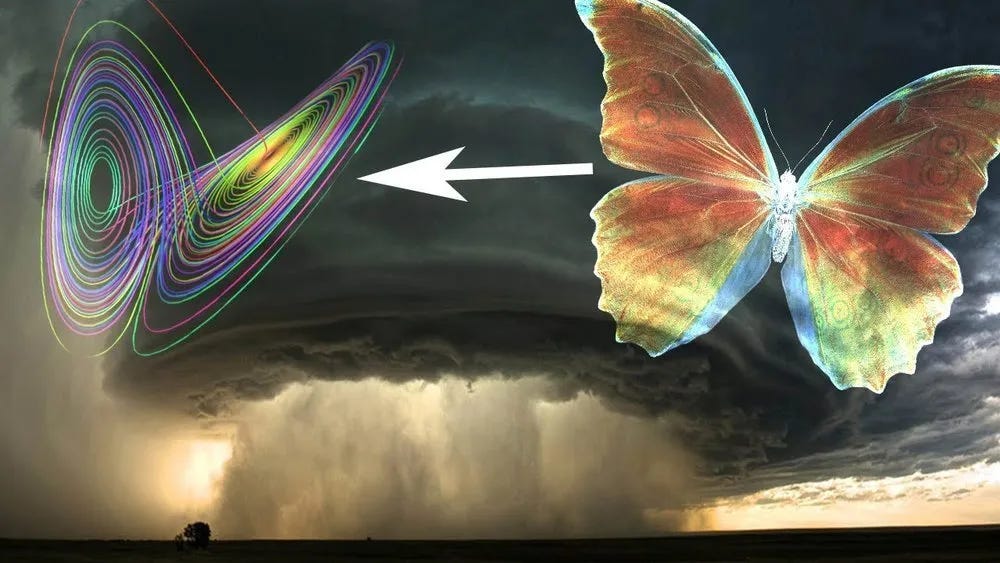
Predicting the future could be seen as a mechanical process, like forecasting the weather: a week in advance is still reasonably possible, but the further ahead you look, the less accurate it becomes. Sometimes, tiny differences in the short term can have a major impact in the long run. This is known as the butterfly effect—a term most people recognise from the (incorrect) anecdote in Jurassic Park that a butterfly in Brazil could cause a storm in California. The weather can influence the outcome of a battle or how many people show up for a protest that ultimately sparks a revolution.
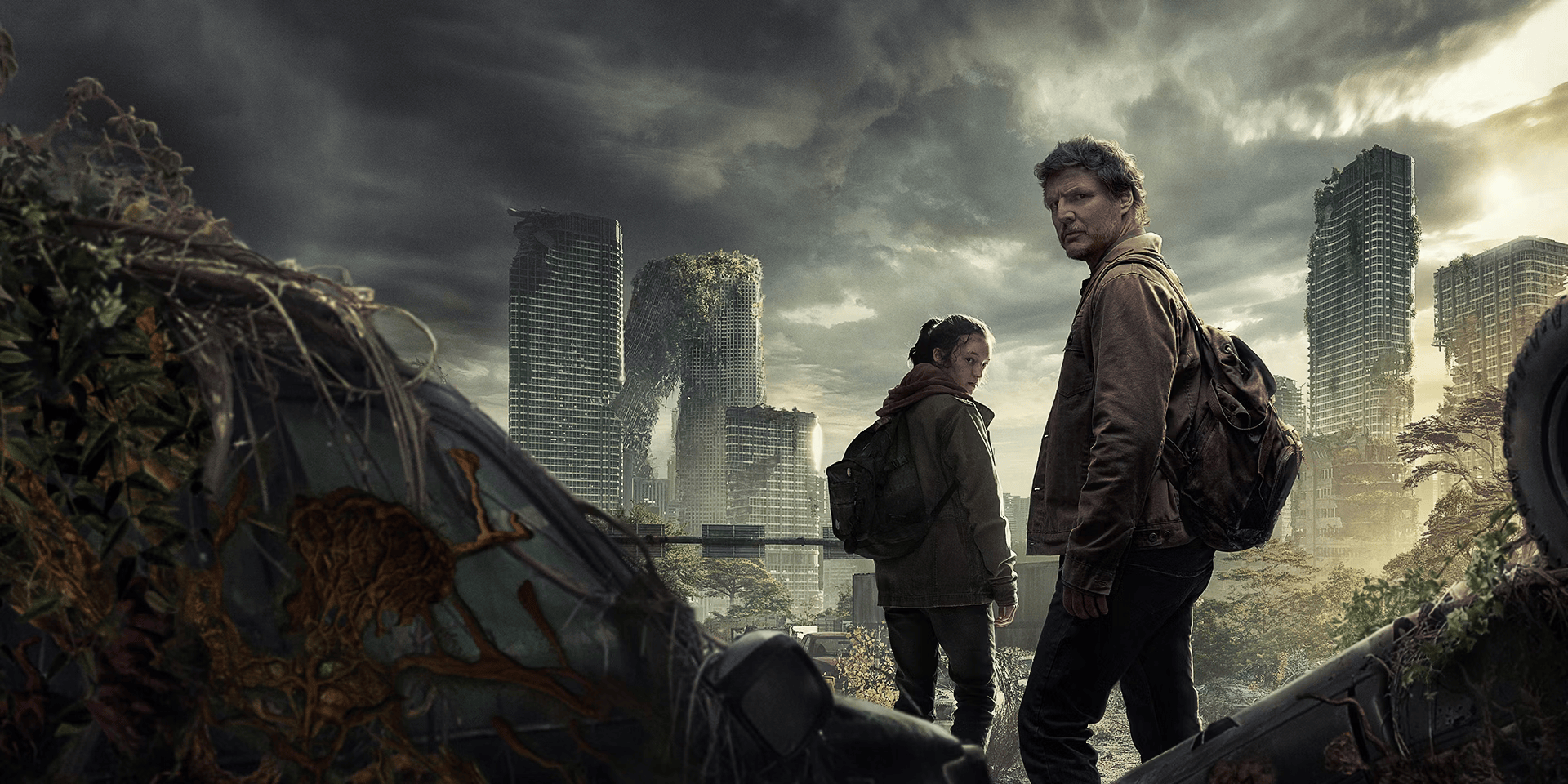
It raises the question what kind of world we would live in if history had taken a different course. What if Germany had won World War II? Or if a nuclear bomb had been dropped during the Cold War? At the end of the 19th century, electric cars already existed, but they were nearly forgotten due to the dominance of the emerging oil industry. In the 1970s, it was not at all a given that everyone would eventually own a personal computer—until Bill Gates convinced the masses. Apple later did the same for smartphones, and now Mark Zuckerberg is trying it with the metaverse.
More subtle still are shifts in ideology and values—beliefs about what life should look like and how we should interact. What is our relationship with the Earth and all of its life? How do we distribute wealth? How do we shape political institutions? How do we view religion, tradition, gender, ethnic and sexual diversity, or family structures and relationships? Different views on these matters can also be (metaphorically, and sometimes even literally) at war with each other, and in many cases, the outcome is still undecided.
The Flashlight
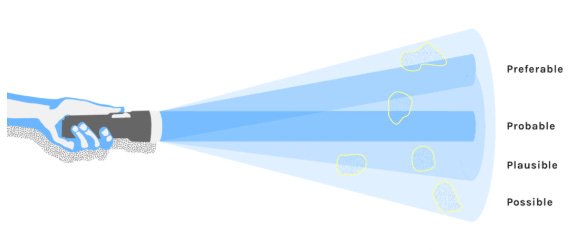
One way to map these things out is the futures cone, a classic method in the field of futures studies. Imagine walking through a dark forest with a flashlight. The beam casts light ahead of you—bright and sharp in the centre, but fading at the edges. In the same way, we use our imagination to look into the future. The light source is the present, and we move in a direction. The closer to the centre of the beam—meaning the more aligned with our current trajectory—the easier it is to imagine a particular future. This is where you can also place quantitative future research, which uses models often based on the present and recent past. These models can predict the near future quite accurately but struggle with unexpected or fundamental changes.
The further from the centre, the more absurd a future scenario seems to us. Everything outside the beam lies in the darkness of the unthinkable. This does not mean it is completely impossible, only that we currently cannot imagine it. However, as we continue walking and change direction, our field of vision shifts, and suddenly, entirely new things become conceivable.
Backcasting
As I described in my earlier article Planting Futures, the depiction and framing of future scenarios in science fiction have an influential and sometimes even decisive impact on the actual course of history—consider the books of Jules Verne. You could argue that not only the past but also (our image of) the future influences the present. A potential future can manifest not only in a physical place but also in thoughts, expectations, and “frames” that spread through collective consciousness via stories and images.
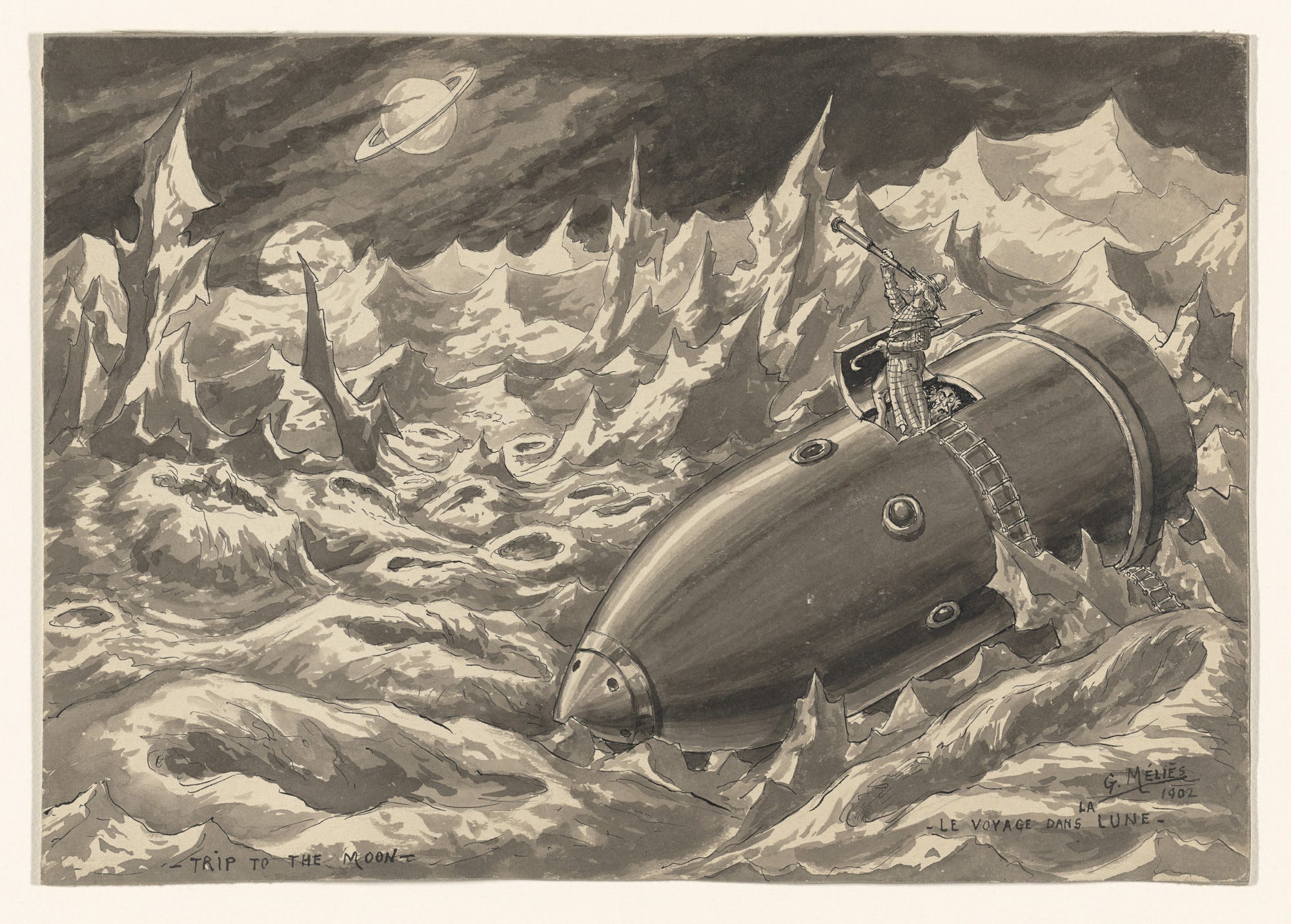
Predicting the future is often about exploring fictional future scenarios and then backcasting them—determining the steps needed, across various domains (social, ecological, etc.), to reach a speculative future world from the present. This helps clarify which aspects of the present need adjustment to avoid dystopia or create a desired future. But how do we know where we want to go?
The Futures Compass
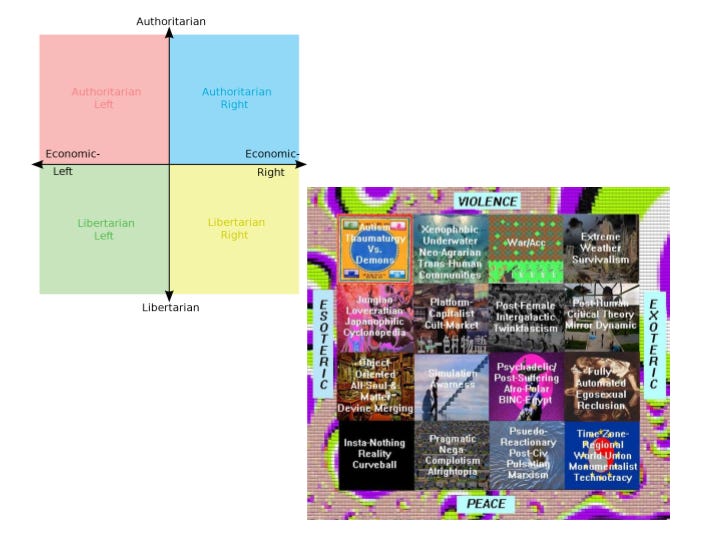
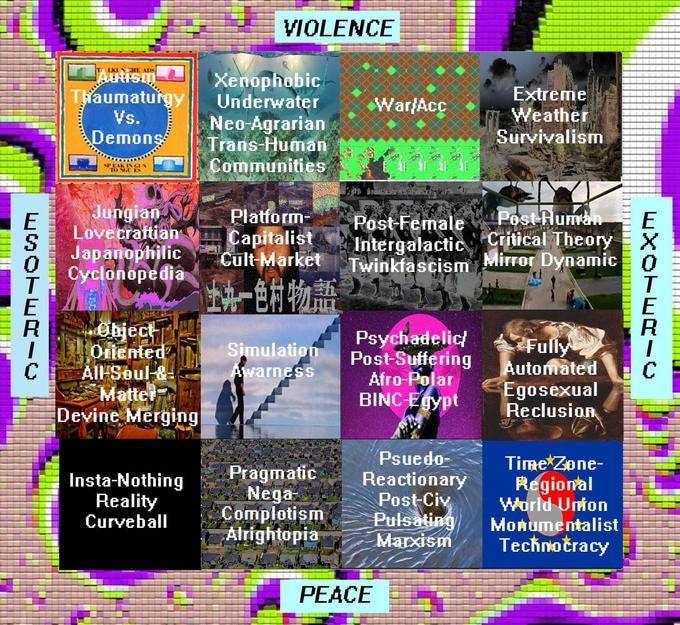
The future compass started as a joke. A parody of the political compass, it presents 4×4 scenarios that differ along two axes. Whereas the traditional political compass maps voters, politicians, and parties along the axes of “authoritarian–libertarian” and “left–right,” the axes on the future compass can vary. The extremes of possible futures are given concrete descriptions, such as “harmonious–chaotic” or “high-tech–post-apocalyptic.”
Although most future compasses are just nerdy fun, they are interesting because even the most bizarre and abstract ideas get captured in an image—giving a small glimpse into something that evokes a certain feeling. In this way, they can serve as a serious method to ask what kind of future we want and why.
Futuring
The way we envision these glimpses of the future is never entirely objective. What attracts or repels us in future scenarios has everything to do with our personal inner world and psychology. What is freedom or security to you? What drives you in your pursuits? How much do you trust people or systems, and when do you not? And as a result: what ideas about how the world should be do you find beautiful or repulsive? Have you ever doubted or changed your mind? Thus, possible futures transform from abstract images and sci-fi films into personal longings, fears, and ideas that dance around us in the present—giving us hope, grounding us, or making us angry or afraid. How can we learn to rise above these emotions and influences and reflect on what moves us, to make more conscious choices?
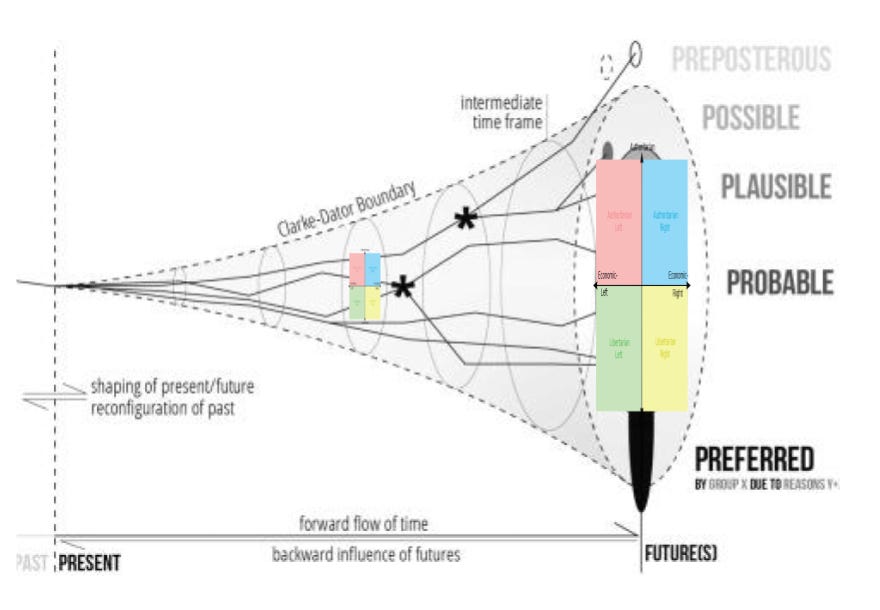
In this light, imagining and backcasting future scenarios belongs as much to psychology and spirituality as to the drawing boards of sci-fi writers, designers, and futurists. It concerns us all. In fact, you could place the future compass over the beam of the flashlight and see every movement—up or down, left or right—as an inner journey toward your own future.
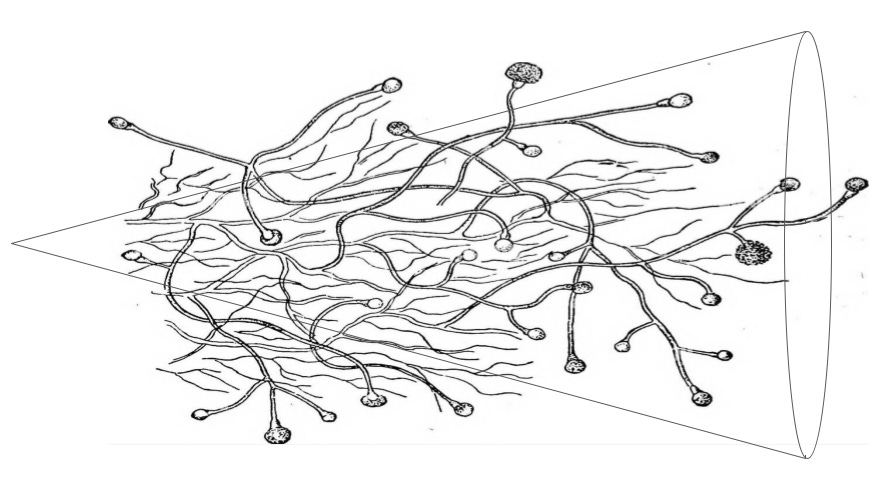
This makes the future an active verb, known in the academic literature as “futuring”: the process of imagining, creating, and sharing future scenarios to expand possibilities for action and connect the past, present, and future. The more people actively engage in this, the more open our future becomes. The path is yours to create.
Further reading
Futuring as a Method
Miller, R. (2018). Transforming the future: Anticipation in the 21st century. Routledge & UNESCO.
Inayatullah, S. (1998). Causal layered analysis: Poststructuralism as method. Futures, 30(8), 815–829.
Futuring in Practice
Oomen, J., Hoffman, J., & Hajer, M. A. (2022). Techniques of futuring: On how imagined futures become socially performative. European Journal of Social Theory, 25(2), 252-270.
Wright, G., & Cairns, G. (2011). Scenario thinking: Practical approaches to the future. Palgrave Macmillan.