Feeling Tomorrow
How Cinema Can Bring Future Worlds to Life

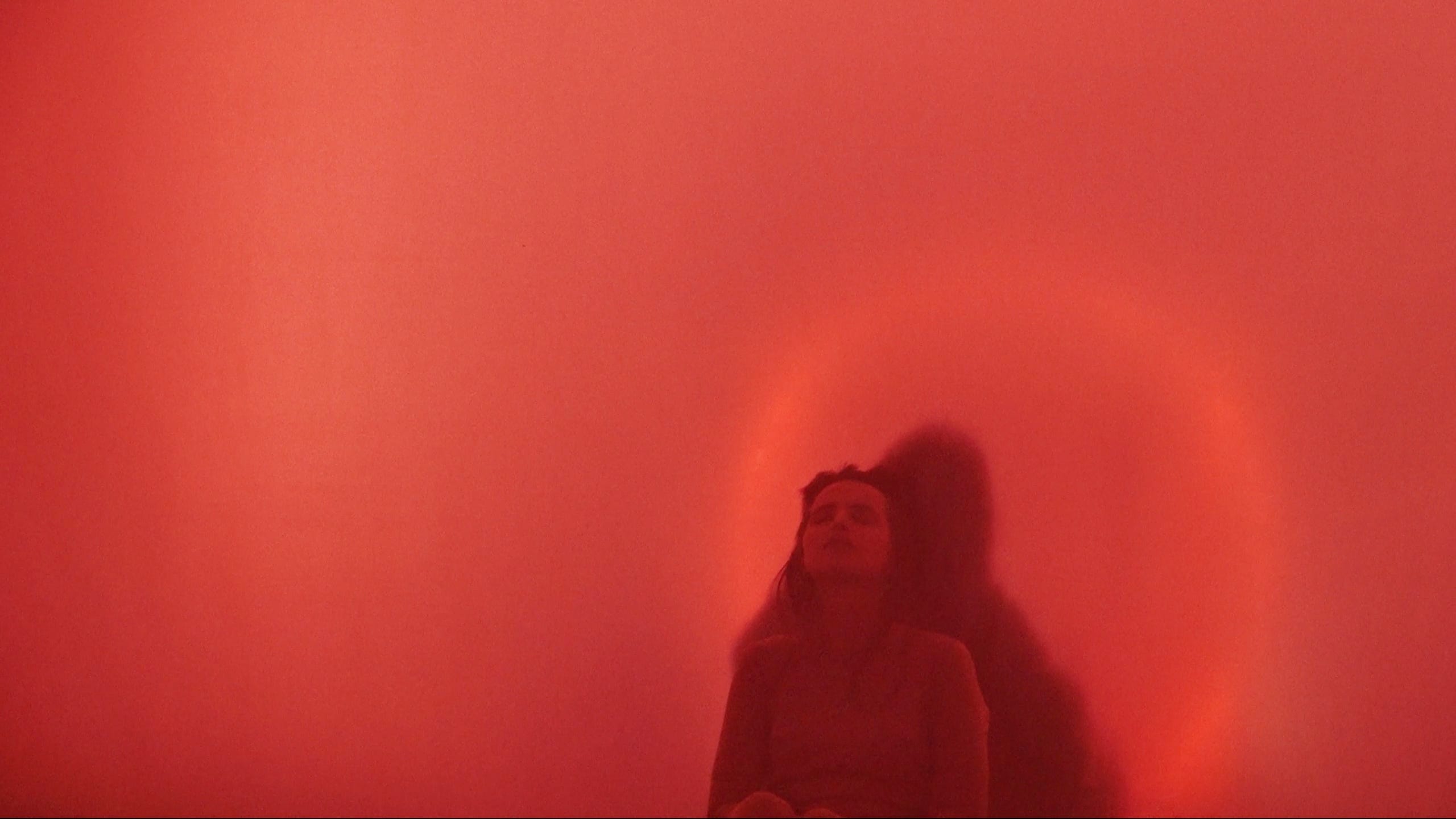
The Power of Felt Worlds
What stays with you after watching Blade Runner isn’t just the story of androids and memory. It’s the emotional grip of rain-soaked streets, neon reflecting in puddles, and the crushing weight of those towering, smoke-belching buildings. The film’s lasting power comes from making you feel what that future would be like—its texture, its mood, its atmosphere.
Great science fiction doesn’t just tell us about possible futures—it lets us experience them. Written stories do this through vivid descriptions, while cinema can immerse us even more directly, using a designed palette of sights, sounds, and rhythms that bypass our rational minds and speak directly to our senses. In our own work, we try to evoke futures through atmosphere rather than exposition. In Dolphin Waves, a wide-angle opening dissolves into drifting aerial shots and a glowing infinity-mirror room, creating a sense of weightlessness—of being suspended in a boundless, fluid reality. Dragonfly, by contrast, draws its intimacy from grounded gestures: soft light, gentle focus, and camera angles that suggest not surveillance, but care. As if something just beyond the frame is quietly watching over you—not human, but present, like a guardian spirit.
In our research project, Embodied Ambitopias, Emilia Tapprest and I explore how to craft atmospheric experiences that reflect how different types of possible future worlds might feel. As a designer turned filmmaker, Emilia specialises in affect—the emotional weather of a moment, sensed through the body before it’s named, shaped by the mood of spaces, systems, and emerging technologies. Her focus is especially on speculative near-future techno-social environments that haven’t yet become part of everyday life.
Our collaboration began when Emilia was shifting the focus of her research and filmmaking around Sonzai media—moving away from the technology itself and toward the value paradigms that shape and are shaped by it. Her 2019 film Sonzai Zone was made in the same year Shoshana Zuboff’s The Age of Surveillance Capitalism sent shockwaves through public discourse on technology and society. Sonzai Zone imagines Sonzai media integrated into a near-future society still governed by the logic of surveillance capitalism. This vision, combined with the growing global awareness of and anxiety about the rise of techno-authoritarianism in China, raised urgent questions: Can technology be imagined differently? And more specifically: What alternative value paradigms could guide the design of emerging techno-social systems? How might the same set of technologies—AI, ambient media, bio-sensing—manifest in radically different ways across cultural and economic contexts, shaped by what each society values most? Our three future worlds don’t just speculate about new tools, but about the moral, aesthetic, and emotional frameworks that guide how those tools are integrated into everyday life.
This is where I entered the process. Although I didn’t yet have direct experience in futures studies, my background in Science and Technology Studies (STS) and my interest in techno-social trends and music subcultures gave me a relevant set of tools complementing Emilia’s design background. I drew on these to help design the affective atmospheres of three distinct, viscerally believable near-future worlds—each shaped by its own values and social systems. My role became one of creative direction, tuning the emotional tone of each world through its sounds and aesthetics: textures, colors, shapes, garments, and rhythms. I was not just concerned with technical or political plausibility but also with emotional plausibility—what it feels like to inhabit that world rather than our own. After all, powerful worldbuilding isn’t just about detailed systems and structures—it’s about creating worlds that feel real enough to step into.
The Stories Worlds Tell About Themselves
Every society tells stories about itself. These narratives—often invisible to those living within them—shape how people understand their reality and their place in it. Much like the special glasses in the film They Live, which reveal hidden messages embedded in advertisements, we can learn to recognize the pervasive stories that legitimize different social systems. By examining these stories, we can ask crucial questions: Who benefits from them? Who is excluded? What values do they uphold, and which do they neglect?
As explained in my previous article Tending Ambitopiass, the worldbuilding in this project is “ambitopian” in nature. It seeks to visualize the tensions between different value paradigms, each of which, despite its contrasts, carries a utopian impulse—offering a more hopeful future than the current apocalyptic horizon. Ambitopian worldbuilding is especially suited to unpacking complex rhetorics and atmospheres because it refuses the conventional approach of glorifying or vilifying utopian and dystopian sci-fi worlds. Rather than simply depicting worlds we dislike as ugly and those we prefer as beautiful—steering the audience toward a particular value judgment—it aims to create atmospheres so believable and immersive that they provoke different emotional responses in contemporary audiences. Some might find a particular world terrifying, while others could find the same world comforting or even exciting, depending on their own unconscious value paradigms.
Each of our three future worlds tells its own unique story:
Dolphin Waves celebrates individual freedom through technological transcendence, promising that immersive play and virtual experiences can allow people to escape physical limitations and achieve higher states of consciousness. This world says: “True freedom means leaving behind material constraints; your imagination is the only limit.”
Dragonfly promotes harmony, balance, and collective well-being. It presents a future where AI aligns human needs with ecological processes, creating a sustainable society in which individual desires are in sync with collective interests. This world claims: “We can find perfect balance between all living things; technology will help us live in harmony.”
Project Gecko champions embodied connection and democratic participation, celebrating physical presence, community autonomy, and the wisdom that emerges when diverse bodies engage in dialogue. This world declares: “Real autonomy happens through our bodies; true democracy requires inner healing.”
Finding Visual Languages for Future Affects
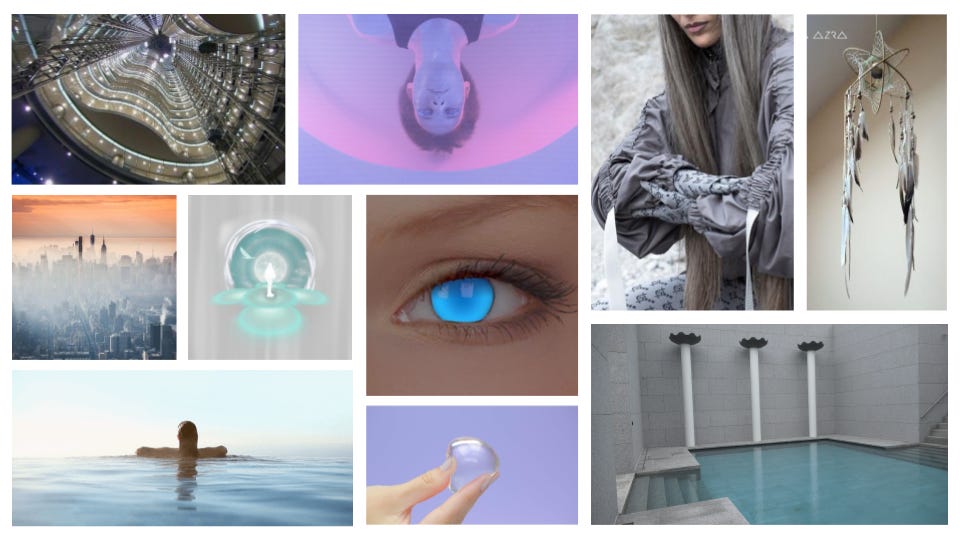
To make these messages experienceable, we aligned each world with distinct visual styles that evoke corresponding feelings using associative moodboards.
For Dolphin Waves, the visual style conveys a luminous techno-ethereality. Blending elements of contemporary wellness glamour, the bright metropolitan futurism of ‘gen X soft club’ and ‘Y2K aesthetics’ and the videogame-like glow and dynamic immersion of ‘Frutiger aurora’, ‘dark aero’ and ‘metalheart’, this mix dissolves the boundaries between the physical and the virtual, promising a transformative transcendence of material limits.
For Dragonfly, the aesthetics reflect a cultivated synthesis of nature and technological sophistication. It draws on early 2010s eco-futurist architecture & design, and the dynamic techno-optimism of ‘Frutiger-aero’ and ‘Frutiger-eco’, evoking a carefully curated equilibrium between human society, ecological systems, and advanced technology. The addition of ‘cottagecore’ and ‘Mori Kei’ elements suggest a return to traditional craft and slow living, while simultaneously pointing to a hyperreal Europe increasingly reliant on the performative revival of its historical heritage as a cultural and economic resource.
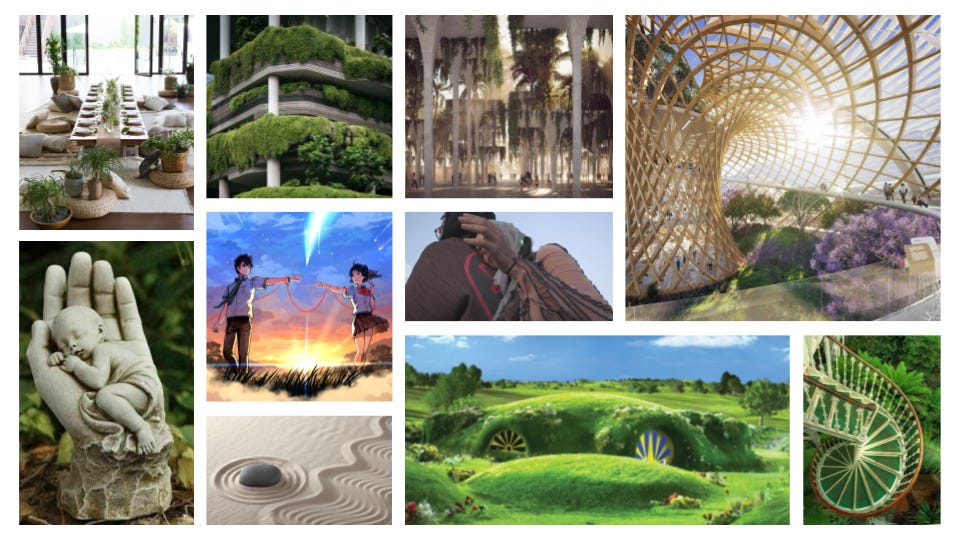
For Project Gecko, the imagery evokes a tactile, grounded sensibility that merges small sale community with a forward-thinking global vision. It revisits the inviting, organic vibe of the 90s ‘global village coffeehouse’ aesthetic, incorporates the warm simplicity of ‘eco-beige’, and nods to early 20th-century earthy abstract art that expressed spiritual truths through organic forms. This approach celebrates embodied connection and promotes a deeply communal and mystical ethos.
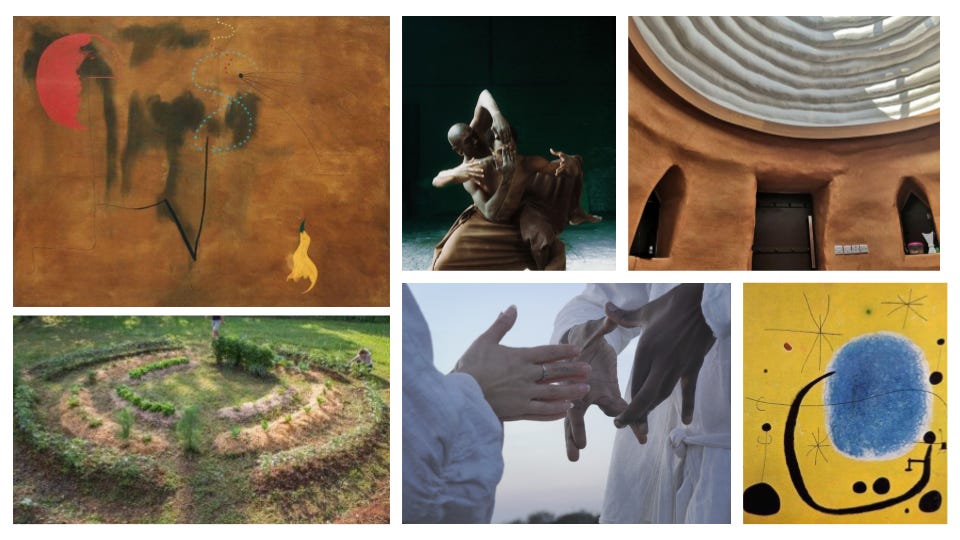
Each visual language aims to engage audiences on an affective level, triggering an unconscious response with regard to the ideological premises of these worlds.
Ritual Cinema
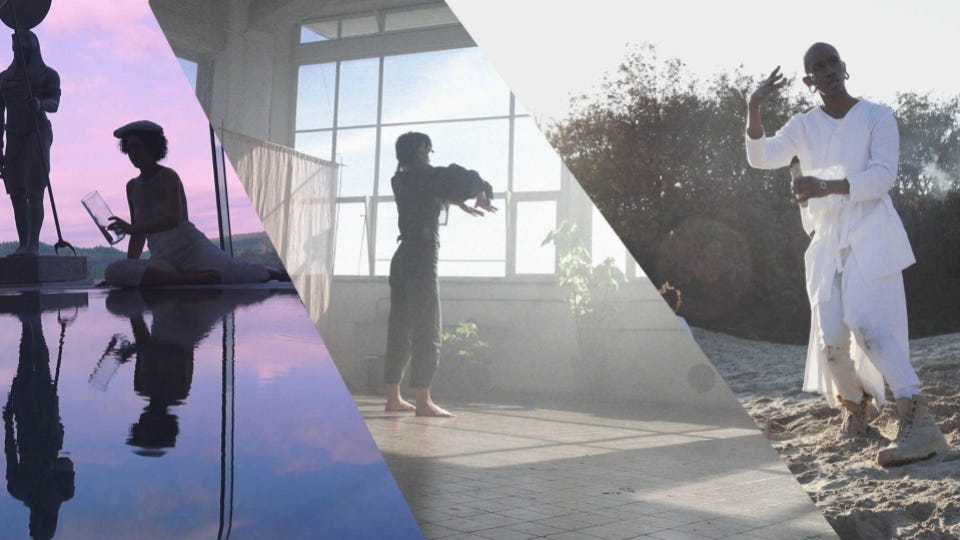
As beginning worldbuiders and filmmakers, it was challenging to translate such an abstract aesthetic understanding of a world’s atmosphere into film, in a way that it feels like a genuinely different world, without relying - like conventional sci-fi - on the literal showing of worldbuilding aspects that do not yet exist, such as specific architecture, transportation infrastructure, specific weather conditions etc. Instead, through a combination of location scouting, costume and prop design but especially experience design on set, we tried to “summon” the atmosphere of the world and experience it as a real, temporarily manifested thing - a method we dubbed ritual cinema. Rather than just visually suggesting a world, we tried to step into it ourselves. Each shoot became a kind of shared ritual, where the cast and crew attuned themselves to the atmosphere of a specific future. By invoking its energy on set—through sound, light, scent (in the form of incense) and movement—we let the world’s atmosphere emerge naturally. What the camera captured wasn’t just acting, but a real, felt experience of being inside that world.
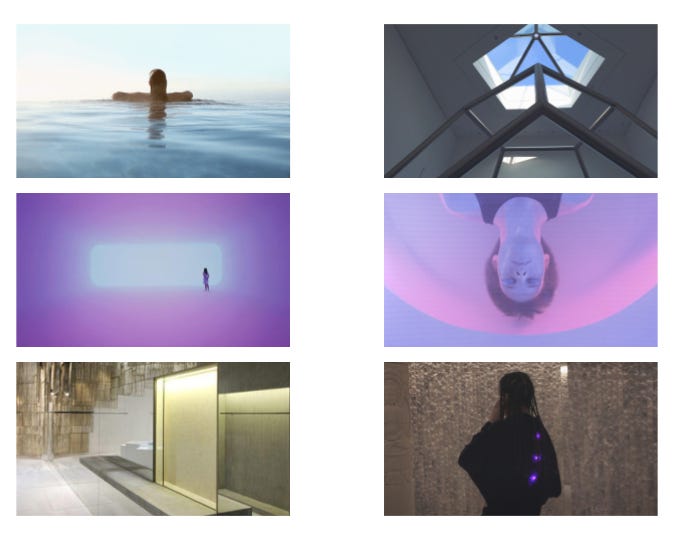
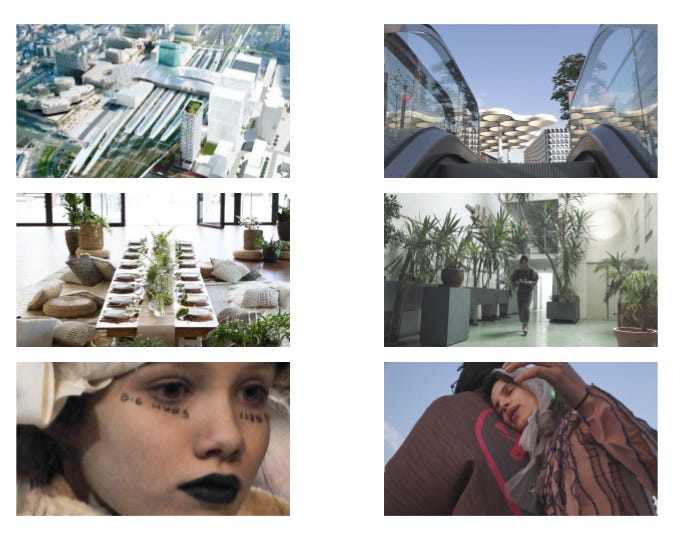
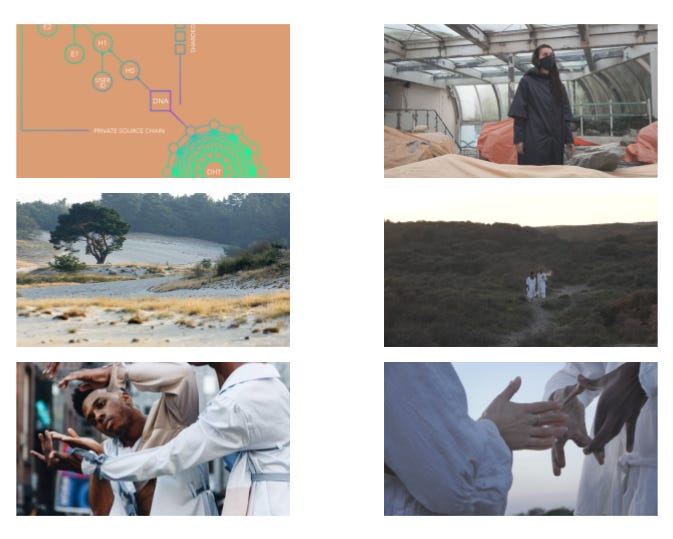
For Dolphin Waves, we had the opportunity to feature a large, luxurious Spa, while for Dragonfly we filmed in an old flat in Amsterdam with historic references aesthetically reminiscent of Dutch Golden-Age painting. Our scene for Project Gecko instead, was set in an abandoned tropical swimming pool dome, a clearly ‘liminal space’, as well as in the desert-like environment of the dunes. Especially Project Gecko we found challenging to convey, avoiding falling back on conventionally solarpunk or hippie aesthetics such as earthships or permaculture gardens. Instead the locations of the abandoned dome and the dunes were chosen for their symbolic value, telling something about the inner journey of the character rather than being physically there per se.
In this way, our cinematic storytelling continuously shifts between three layers: 1.) The world space shows the physical environment—the architecture, technology, and social norms of the society; 2.) The subjective space reveals how characters feel about their world—their emotional responses and personal perspectives and 3.) The symbolic space uses visual metaphors to express deeper themes and unconscious dimensions of the world. By moving between these spaces, our film work tries to create richer experiences of these possible futures, from the subjective perspectives of different characters.
In my next article, I will go deeper into how mind-body exercises serve in our work as natural transitions between these layers, connecting external reality, internal experience, and symbolic meaning.
Atmospheres as Bridges to Possible Futures
The feeling of a future world isn’t just window dressing but essential to understanding what that world values and how it might shape human experience. By creating atmospheric experiences of different possible futures, we can better understand our own values and what kinds of futures we find appealing or disturbing, and thus develop a better intuition of where we want to go.
As we face unprecedented challenges, we need not just new systems but new atmospheres—new ways of being that can appeal to something deeper. By bringing these atmospheres to life through cinema, we can expand our collective imagination and create richer conversations about our shared future.
What atmospheres draw you in? What sensory qualities make you feel most alive or connected? The futures we create will be not just the ones we can intellectually imagine, but the ones that resonate with our bodies—the ones that feel right.
Further reading
Affective Atmospheres in Cinema
Tapprest, E., & Evink, V. (2021). Ambitopia and affective atmospheres: How world-building and cinema can help unpack ideology inside pervasive systems. Interface Critique, 3, 87–101.
Böhme, G. (1993). Atmosphere as the fundamental concept of a new aesthetics. Thesis Eleven, 36(1), 113–126.
Bruno, G. (2014). Surface: Matters of aesthetics, materiality, and media. University of Chicago Press.
Anderson, B. (2009). Affective atmospheres. Emotion, Space and Society, 2(2), 77–81.
Worldbuilding through Emotional Plausibility
Fisher, M. (2016). The weird and the eerie. Repeater Books.
Landsberg, A. (2004). Prosthetic memory: The transformation of American remembrance in the age of mass culture. Columbia University Press.
Murray, J. H. (1997). Hamlet on the Holodeck: The future of narrative in cyberspace. MIT Press.